Guide
Application rationalization: what it is and how it actually works
Application rationalization is the structured practice of assessing every business application in a portfolio and deciding what happens next — keep, modernize, replace, or retire. The goal is clarity, not cost savings.
Every application has a plan.
What rationalization produces
A completed rationalization cycle is easy to recognize: every application in scope has a named business owner, scores against business and technical factors, a placement on the TIME quadrant, a near-term action, and a roadmap item for the next twelve months. Not a strategy essay. Not a separate project. A row in a table where every cell is filled in.
The portfolio that emerges from those rows is what lets an organization see itself clearly enough to make better decisions about how work gets done — which applications earn their place, which need a path forward, and which should be retired on purpose instead of by neglect.
Not a cost-savings program
Here is the part most rationalization pitches get wrong: retiring applications, on its own, does not usually save meaningful money. Licenses overlap, infrastructure is shared, and the labor doesn't disappear with the login page. Programs sold on decommissioning savings tend to disappoint — and then stall.
What actually moves the needle is what the clarity enables: duplicated work surfaces, misaligned investment becomes visible, business processes get sharpened, and every renewal conversation starts from evidence. The financial outcomes leadership wants follow from that work. The applications themselves are downstream of it.
Rationalize for clarity. The savings are a consequence, not the plan.
How portfolios get this way
Nobody plans for application sprawl — it happens one quick win at a time. Each team solves its own problem, each tool arrives with a good reason, and a decade later the organization runs hundreds of applications with unclear ownership, overlapping functions, and costs nobody can fully explain.
Rationalization is the deliberate answer: not a purge, but a practice that puts every application through the same assessment and gives every one of them a plan.
The method: from inventory to roadmap
Rationalization isn't a workshop you improvise — it's a sequence. Each step below is a full guide.
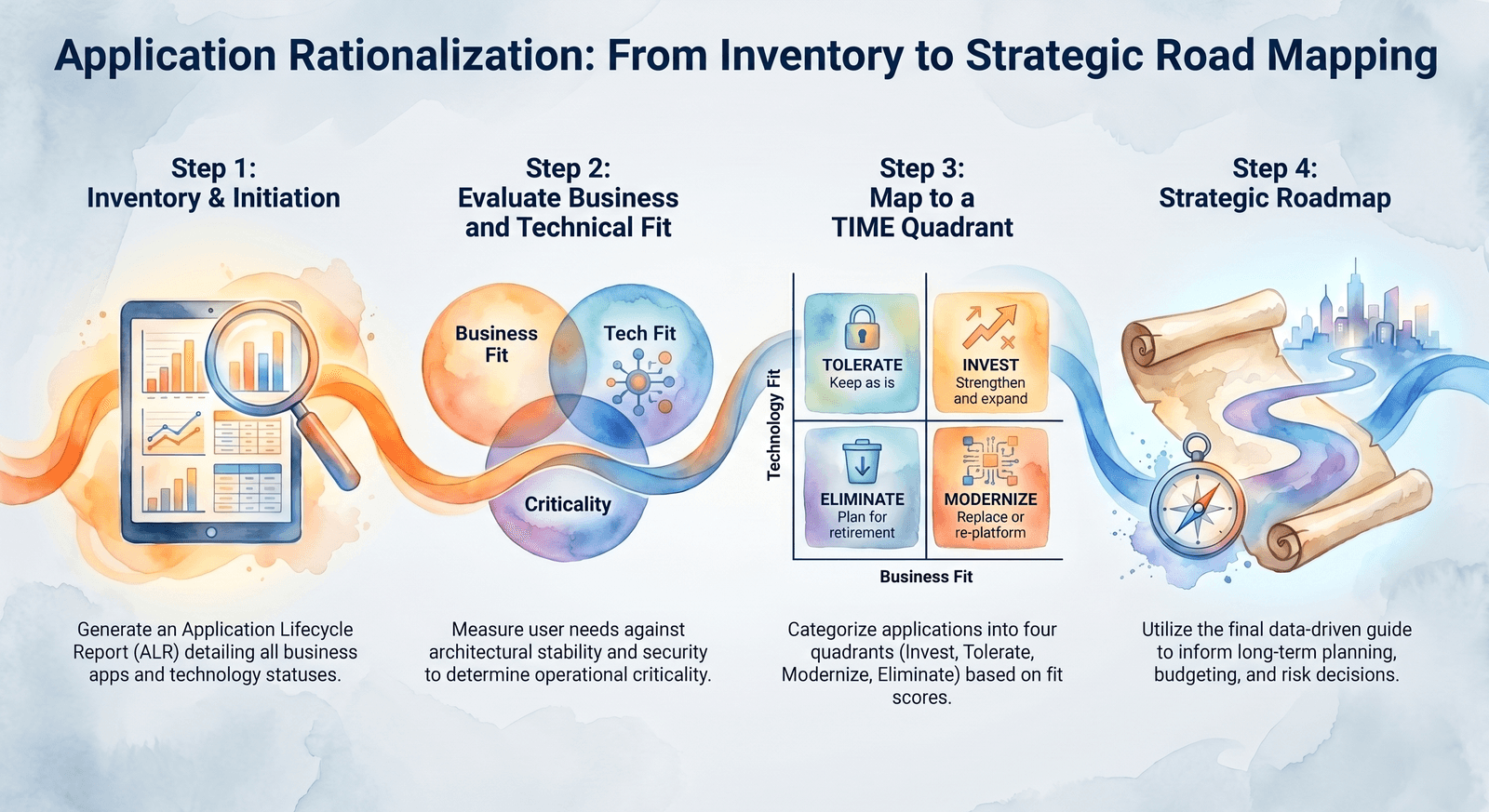
The four-step methodology. (The artifact labels the vertical axis "Technology Fit"; the canon name for the same dimension is Technical Health.) Full TIME definitions — the TIME framework.
Where GetInSync fits
Rationalization needs a system of record — somewhere the inventory, scores, placements, and roadmap live between workshops and survive between quarters. GetInSync is that system: applications are scored in facilitated sessions, TIME and PAID placements derive from the scores, and the portfolio stays current on a quarterly rhythm instead of being rebuilt every budget season. See the portfolio view.
Common questions
- Is application rationalization a cost-savings program?
- No — and treating it as one is why many programs disappoint. Retiring applications, on its own, does not usually save meaningful money. The value is clarity and improved business processes; the financial outcomes leadership wants follow from that work, with the applications downstream of it.
- What does a rationalization cycle produce?
- A portfolio where every application in scope has a named owner, business and technical scores, a TIME placement, a PAID action, and a roadmap item for the next twelve months — a row in a table where every cell is filled in, ready for leadership decisions.
- How is rationalization different from application portfolio management?
- Application portfolio management is the ongoing discipline of knowing and managing what you run. Rationalization is the deciding part — assessing each application and choosing what happens next. Done well, rationalization isn't a one-time project; it's the natural output of a portfolio kept current on a quarterly rhythm.
- What triggers an application rationalization effort?
- The usual triggers: a budget review that can't explain the application line, a merger or reorganization that doubled the portfolio, a cloud or modernization program that needs to know what's worth moving, a security review that found systems nobody owns — or a new IT leader who asks what we run and gets three different answers.
More on the broader discipline in the knowledge base.
Ready to run it?
The workshop guide walks the whole practice in five run books — with a free kit of handouts, templates, and the playbook.